
In the time it takes you to read this sentence, approximately 1.5 million posts will have been published across social media platforms worldwide. Some will go unnoticed. A few will go viral. And at least one of them will be about a brand.
5.79 Billion people uses social media till 2026 (BL). This surge of users left an impact on how customer behaves towards a brand. Social media platforms provide an intractive environment where brands can engage with there customers. Customers can create a bond with their preferable brands. Social media has not changed how a brand communicates. It has changed how brands are. If you are a marketer, a business owner or someone building a brand, this article is for you. We will explore exactly how social media is reshaping brand identity, trust and loyalty right now and what you must do to stay ahead.
New Brand Monologue
Few years ago, there was a time when the communication between brands and social media was one way. They broadcast and the customer listens. That is over. Now customers are not the passive receipents of the messege. They are co-authors of a brand story. They tweet about customer service. Also post unboxing videos, write reviews, and share their experiences in real time with thousands of followers. Nearly half of all customers (48%) now interacts with brands on social media more frequently than they did few years ago. The conversation has become bidirectional and some brands that still operate in monologue mode are losing ground fast. The modern brand is defined not just by what it says but by how it listens, how fast it responds, and how authentically it engages.
Brand Reputation As An Asset
Think about what it meant for a brand to have a ‘reputation‘ ten years ago. It was a slow moving thing built through advertising, word-of-mouth, and media coverage over months and years. Today brand reputation moves at the speed of a retweet. Let’s look at some incidents which shows us how quickly a brand image is altered by social media.
- In 2024 Kellogg’s CEO suggested that families eat cereal for dinner as a cost saving measure during high inflation. Social media exploded before PR could respond, with #BoycottKelloggs trending on TikTok within hours
- Delta Airlines faced backlash over a uniform policy in July 2024. Its social team responded insensitively to a viral post, accelerating a narrative the brand had no plan for.
This is the new reality. Your brand’s reputation is not just about what you do, it is about how you are perceived to respond when things go wrong. Social media has turned reputation into a live and dynamic asset that requires attention consistently.
Interactivity- The Currency Of Trust
One of the most important and underappreciated insights in modern brand strategy is trust. It is not just the quality of your content that builds trust. It is the quality of your conversations. Research consistently shows brands that engage in genuine two-way dialogue are perceived as more agile, more competent and more trustworthy. This goes beyond simply replying to comments.
It simply means:
- Responding quickly to questions and complaints
- Actively encouraging dialogue and feedback
- Adapting your tone and content based on what your audience is telling you
Research by Sprinklr data shows that 71% of customers who receive a quick response on social media will likely recommend that brand. A single timely reply is best customer service. And brand should handle the reply system with utmost care and responsibility. Every reply is a data point. Each interaction is a building block. Ignored comments are missed opportunity or worse, a visible signal of indifference.
The Agility Factor
When a brand responds with speed and substance, it does something powerful. It signals to customers that the organisation is adaptive and capable. Researchers call this ‘Perceived Social Media Agility‘. Customer can sense that a brand can detect and respond to changes in real time. This perception of agility is directly linked to brand trust and ultimately towards brand loyalty. It is not just a nice to have. It is a competitive differentiator.
Content, Authenticity And UGC
Certain content formats are dramatically outperforming others when it comes to brand building on social media.
Short Video
81% of consumers want brands to release more short-form video content. Short-form videos are proven to be 2.5 times more engaging than their long-form counterparts. TikTok, Instagram reels and YouTube shorts have fundamentally changed the content landscape. Brands that don’t have it, losing visibility fast.
UGC Content
Consumers trust other consumers more than they trust brands. Studies show that user generated content (UGC) influences purchase decisions almost 10 times more than influencer content. Encouraging your customers to create content about your brand and then amplifying that content is one of the highest ROI strategies available in the market now.
From Engagement to Loyalty
Here is the model that separates strategically excellent brands from those that are simply active on social media:
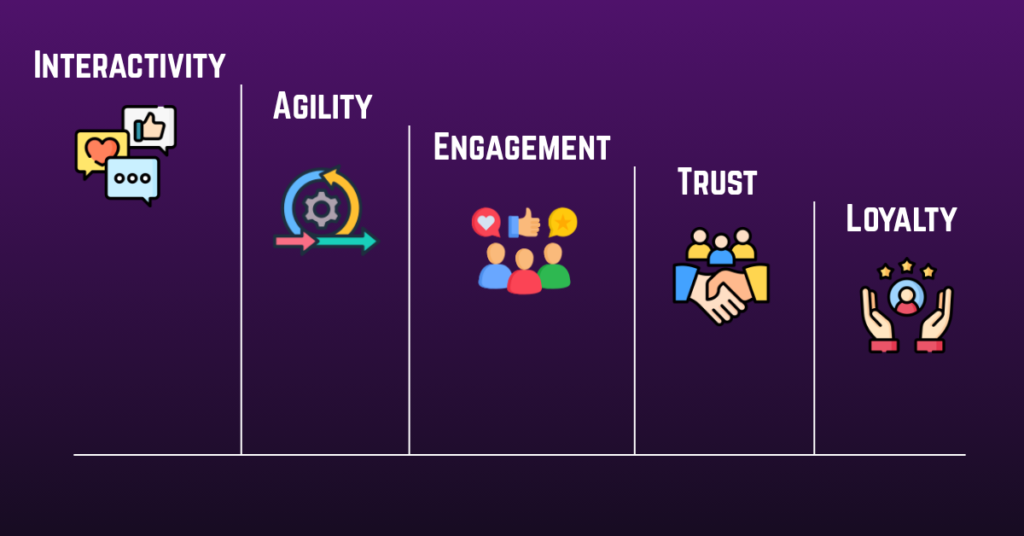
Interactivity → Perceived Agility → Engagement → Trust → Loyalty
Each link in this chain matters. Interactivity without agility is just noise. Engagement without trust is just vanity metrics. Trust without consistent reinforcement decays. The brands that wins are those who understand social media not as a broadcast channel or even purely as a customer service tool but as a trust-building engine. Every post, every reply, every story, every DM is either depositing into or withdrawing from your brand’s trust account. If you loose trust, it’s extraordinarily hard to rebuild. Research from multiple crisis case studies confirms that reputational damage from poorly managed social media incidents can take years and millions in marketing spend to reverse.
Social Media Brand Strategy
Based on the research and insights covered in this article, here are some specific improvements you can consider to have the highest impact on your brand’s social media performance:
1. Conduct an Interactivity Audit: Review your last 90 days of social media activity. Are you responding? How quickly? Are you genuinely engaging or just broadcasting? Tools like Sprout Social, Hootsuite, or Sprinklr can give you a clear picture.
2. Build a Social Crisis Playbook: Before a crisis hits, define your response tiers, pre-approve key messages, assign clear roles across marketing, PR, legal, and customer service. Speed and coordination win crises and you can only achieve those with preparation.
3. Invest in Platform-Specific Content: Stop repurposing the same post across every platform. Create content natively for each platform’s format and audience mindset. .
5. Amplify User-Generated Content Deliberately: Create campaigns, hashtags, and prompts that encourage customers to generate content. Then curate, credit, and amplify the best examples. This is the highest-trust content you can put on your channels.
6. Personalise by Audience Segment: Research shows that different demographic groups respond differently to brand interactivity signals. Tailor your tone, content type, and engagement strategy based on who you are speaking to not just what you want to say.
7. Integrate AI Thoughtfully: 71% of social media marketers now use AI tools. Use AI for social listening, sentiment analysis, content ideation and response drafting but always keep a human in the loop. Consumers can detect automated responses, and they distrust them.
8. Track Brand Trust, Not Just Engagement: Move beyond likes and follower counts. Track sentiment, share of voice, response rates, and brand recall metrics. These are the indicators of whether your social media activity is actually building brand equity or just generating noise.
Conclusion
Social media has not just changed marketing. It has changed the fundamental nature of what a brand is, how trust is built and how loyalty is earned. The brands that will thrive in the years ahead are not necessarily those with the biggest budgets, the most followers or the cleverest campaigns. Your social media presence is no longer a marketing function. It is a core business function. Treat it accordingly.