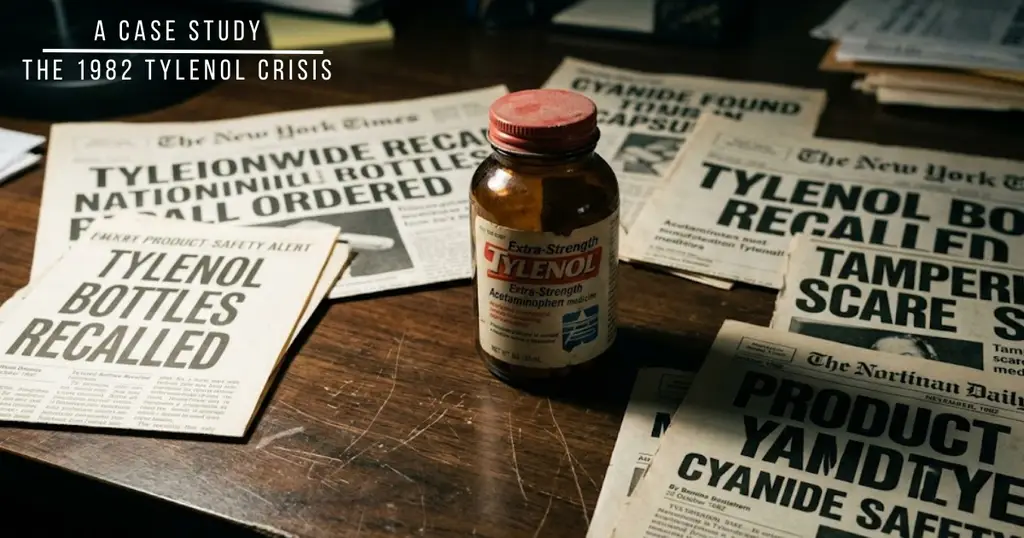
Imagine waking up one morning and you discover that your company’s most profitable, beloved product is suddenly killing your customers. In 1982, Johnson & Johnson faced a CEO’s worst nightmare. An invisible killer weaponized the most trusted painkiller in America, turning it into a lethal poison and triggering a nationwide panic. Everyone was believing that the brand was dead. But what happened next became the greatest comeback story and case study in corporate history and set the gold standard for how to handle an impossible crisis.
The Tragedy Unfolds
It was Wednesday, September 29, 1982, in Elk Grove Village, Illinois. Twelve-year-old Mary Kellerman woke up with a sore throat and a runny nose. Hoping to soothe her symptoms before school, her parents gave her a single Extra-Strength Tylenol capsule. Within hours, Mary collapsed on the bathroom floor and tragically passed away. That same day, a 27-year-old postal worker named Adam Janus took Tylenol for a headache and died later. One thing was common for all of them, each had ingested Extra-Strength Tylenol. Someone had systematically taken Tylenol off store shelves,
opened the capsules, replaced the medicine with up to 600 milligrams of cyanide.
Johnson & Johnson’s Pre-Eminence
To understand the magnitude of the crisis, one must understand what Tylenol meant to its parent company, Johnson & Johnson (J&J), and to the American public. Produced by J&J’s subsidiary McNeil Consumer Products, Tylenol was the undisputed king of over-the-counter (OTC) pain relief. Prior to September 1982, Tylenol held a staggering 37% market share outselling its next four leading competitors combined. Tylenol accounted for 19% of Johnson & Johnson’s total corporate profits and drove 33% of the company’s year-over-year profit growth. Approximately 100 million Americans trusted the brand.
How the Crisis Shattered the Brand
People started panicking after hearing the news. Hospitals across the country were flooded with calls from citizens fearing. In Chicago, police was announcing door to door ‘Do not take Tylenol! Flush it down the toilet!’. Almost overnight, an estimated 90% of the American public became aware of the crisis. For Johnson & Johnson, the business fallout was catastrophic. Thus within days, Tylenol’s 37% market share went down at 7%. The company’s stock price dropped rapidly, wiping out billions in market value. Financial analysts and marketing experts declared the brand dead, confidently predicting that the name ‘Tylenol’ would disappear from shelves within a year.
An Unprecedented Response
James Burke, the Chairman and CEO of Johnson & Johnson, first learned of the poisoning not from an internal warning system, but from a Chicago reporter calling for a comment. He immediately formed a seven member crisis strategy team and set company’s mission down to two simple directives: (1) How do we protect the people? (2) How do we save this product? The FBI and the FDA advised against a nationwide recall, arguing it might encourage future extortionists. Thus Burke faced immense resistance. However, he made a historic decision. He ordered a nationwide recall of every single Tylenol product totalling 31 million bottles and approximately 330 million tablets.
The Transparency
Unlike many corporations that hide behind lawyers and ‘no comment’ statements, Burke chose radical transparency. The company utilized a ‘forgiveness and sympathy’ strategy. So they positioned J&J as an unfortunate victim of a malicious crime while taking complete responsibility for consumer safety. Burke appeared on major platforms like 60 Minutes and The Donahue Show. Looking directly into the camera, he explained the situation with honesty. J&J set up consumer hotlines and even paid for advertisements actively telling the public not to use their product
Overcoming the Crisis
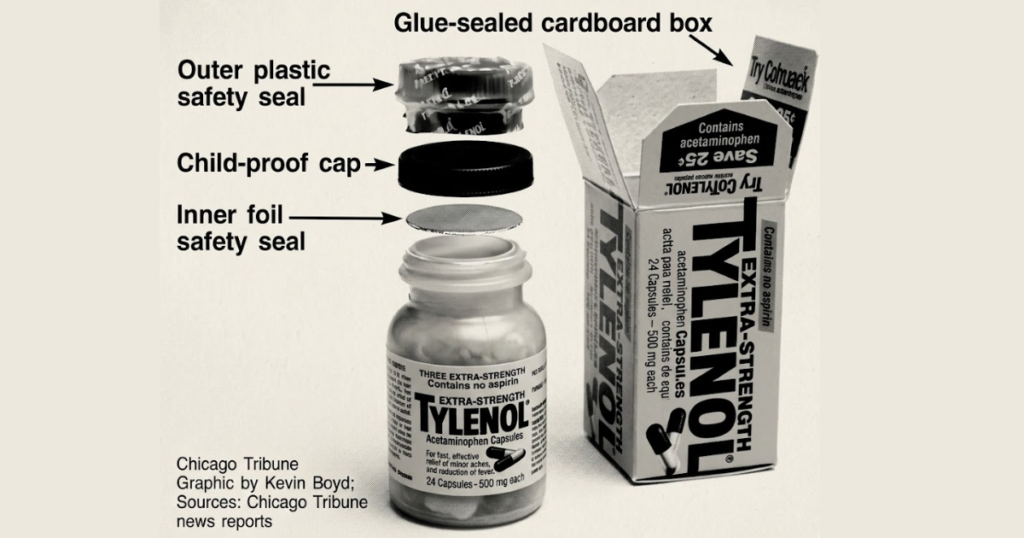
Within just six weeks, J&J pioneered a massive innovation ‘tamper-resistant packaging‘. They introduced the industry’s first ‘triple-seal’ system. A glued outer box, a tight plastic shrink seal around the bottle’s neck and a foil seal covering the mouth of the bottle. To regain trust of consumers, J&J distributed 80 million coupons worth $2.50 each. They were giving away the new, safer Tylenol for free. They mobilised over 2,000 employees to personally visit medical professionals to rebuild confidence. The result? Within just five months, Tylenol had recovered nearly all of its 37% market share. By the end of the year, it was once again the number one painkiller in America.
Aftermath
Despite a massive multimillion dollar investigation involving 130 investigators and thousands of leads, the true ‘cyanide killer’ was never definitively caught. However the primary suspect, James William Lewis sent an extortion letter to J&J demanding $1 million to stop the killing. Though he served 13 years in federal prison for extortion. Investigators never found enough hard evidence against him for the murders. He maintained his innocence until his death in 2023. The tragedy changed American law forever. Therefore this crisis directly led to Congress passing the Federal Anti-Tampering Act of 1983. Today every time you peel the foil seal off a bottle of aspirin, you are experiencing the direct legacy of the
1982 Chicago Tylenol crisis.
Crisis Management Lessons Every Business Can Learn
1. Trust is the Ultimate Business Metric
Trust takes decades to build and seconds to destroy. However, J&J proved that trust can be rebuilt if a company acts with unshakeable integrity, even when it costs everything.
2. Put Values Over Profits
When disaster hit, leadership didn’t need to debate what mattered most decisions were made based on human ethics rather than quarterly earnings.
3. Be Proactive, Not Reactive
They took absolute ownership of the public’s safety. Organizations that step up and take responsibility for situations they didn’t create will always command more public respect.
4. Turn Failure into Innovation
J&J didn’t just apologise they fixed the systemic vulnerability. By inventing tamper-resistant packaging, they turned a devastating safety flaw into a massive competitive advantage, setting a new safety standard for the entire industry globally.
Conclusion
The Tylenol crisis of 1982 proves that doing the right thing isn’t just a moral imperative, it is the best business strategy. By prioritising human life over $100 million in revenue, Johnson & Johnson saved its most lucrative brand. It preserved its legacy, and set a gold standard for corporate citizenship that will echo through boardrooms for generations to come.